
Triage and analysis
One pass, every module
Section titled “One pass, every module”The file analysis modules want the same bytes, so a run reads each file once, whatever you selected: the first 4 KB to identify it, the rest streamed in 64 KB blocks only if a module needs it. Anything not selected stays not measured – distinguishable from measured as nothing. Rows are written in batches, so a 20,000-file image is a few hundred transactions, not 20,000.
| Module | What it finds |
|---|---|
| File type | the type from the content (libmagic), compared with the name |
| Entropy | Shannon entropy, the mean and the highest-scoring block |
| Hashes | SHA-256 always; MD5 and SHA-1 if the case asks for them |
| Hidden data | deceptive names, bytes after a file’s real end, encryption, possible encrypted volumes |
| Photo metadata | EXIF, including GPS – every located photo goes on the map |
| Document authors | authors and editors recorded in Office, ODF and PDF files |
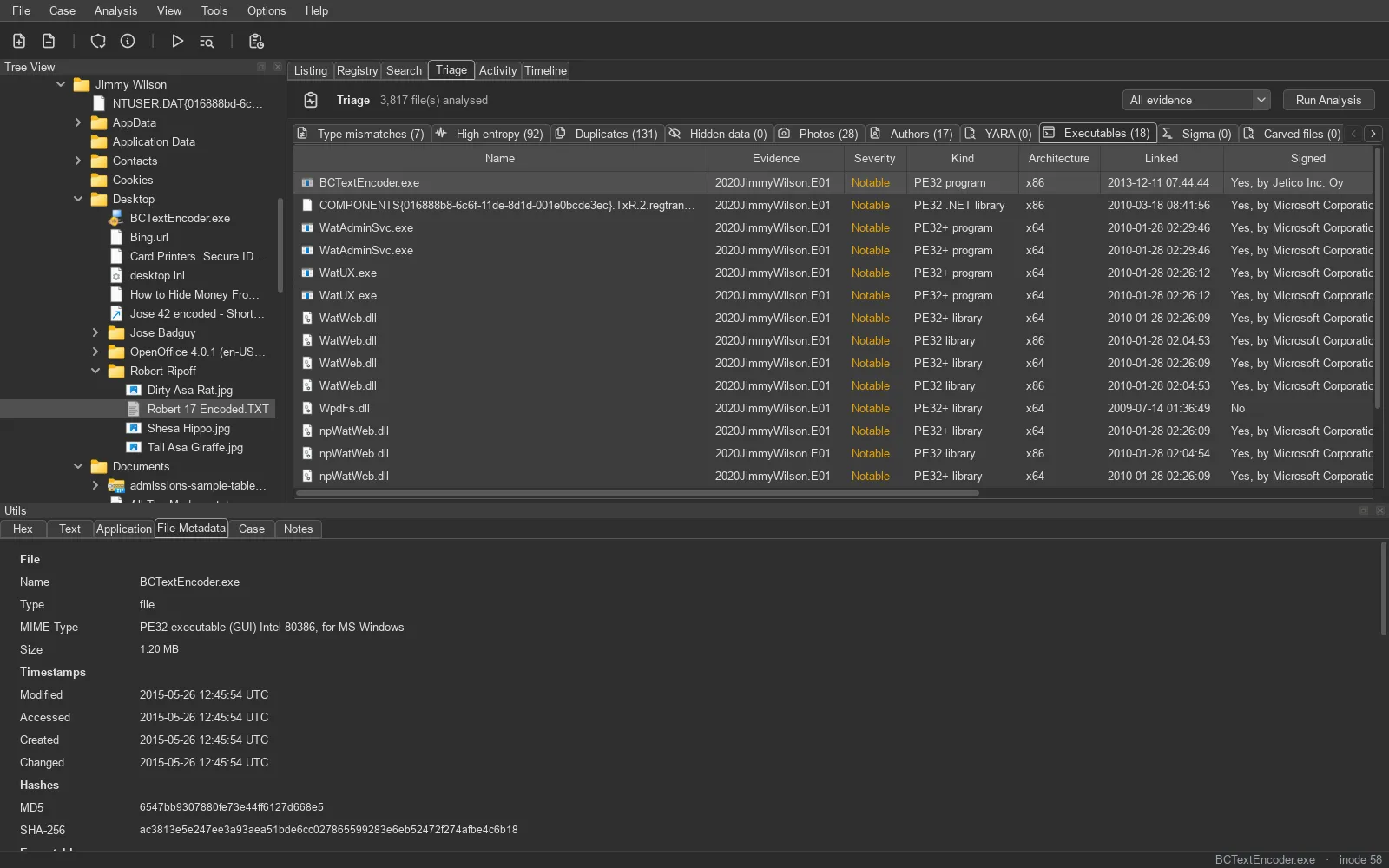
| Executables | PE, ELF and Mach-O: architecture, libraries, signer, overlays |
Graded, not flagged
Section titled “Graded, not flagged”A list that opens with a thousand false alarms is a list nobody reads twice, so findings are graded:
- Suspicious – an executable wearing a document’s extension.
- Notable – content that cannot be identified and scores high entropy, which is what an encrypted file looks like from outside.
- Benign –
.jpeholding a JPEG. Recorded, not reported.
Entropy is judged by type first: a ZIP at 7.99 bits per byte is a ZIP, and flagging it would teach you to ignore the flag. And because a small encrypted payload appended to a photograph hardly moves the mean, the peak block is kept too. Files under a minimum size score 0 rather than a number – over a few dozen bytes, entropy measures how many distinct values appeared, not disorder.
Hidden data
Section titled “Hidden data”- Bytes after the end of a JPEG, PNG or PDF – found by parsing the format, not by searching for the last end marker.
- Deceptive names: double extensions such as
invoice.pdf.exe, and right-to-left override characters that make a name read backwards. - Encrypted documents and archives, and files that look like encrypted volumes.
Executables
Section titled “Executables”PE, ELF and Mach-O (fat binaries too) are parsed by TRACE itself: architecture, imported libraries, build time, signer and any overlay appended after the program. The Authenticode signer is read from the signature – and TRACE says plainly that it is not verified. A reproducible build’s PE timestamp is recognised as a hash, not a time. Triage lists every executable; the Findings node only the notable and suspicious ones. The values are tested against pefile and pyelftools on real binaries (PuTTY, SQLite, BusyBox, bat, ripgrep).
NTFS internals
Section titled “NTFS internals”The NTFS module reads the raw $MFT and $UsnJrnl:$J into events with 100-nanosecond times, plus:
- Timestomping, graded: a
$STANDARD_INFORMATIONtime earlier than$FILE_NAMEalone is benign (installers do it thousands of times); a whole-second SI time where FN has a fraction is notable; both together are suspicious. $I30slack – index entries for files long gone.$LogFilerecords, accepted only where their log sequence number points back to where they sit.
Paths of deleted entries are rebuilt the way libfsntfs does; orphans go under $Orphan.
Thumbnail caches
Section titled “Thumbnail caches”Windows thumbcache_*.db and Thumbs.db, the Windows Search index’s thumbnail IDs (Windows.edb and the Windows 11 Windows.db), and the RDP bitmap cache. Each picture is checked against its original: still present, deleted, or absent – a picture of a file that no longer exists is a finding.
Persistence and hash sets
Section titled “Persistence and hash sets”See Detection: autoruns graded by the file they start, and NSRL and your own hash sets to hide the known and flag the known-bad.
The map
Section titled “The map”Photo GPS and activity records that carry coordinates are drawn on Triage ▸ Map – offline by default, over a bundled world map. Online map tiles are opt-in, asked once per server per session, and audited.